
July 21, 2026
"Digital Bridge" in the Storm: How Do Professional Market-Making Systems Defend the Liquidity Frontline Amid Extreme Market Conditions?
Core HighlightsOn August 5, 2024, global markets experienced sharp volatility, testing not only market makers' quoting strategies but also their trading systems' resilience to extreme pressure. As a liquidity provider for HKEX's USD Gold Futures, Delta Horizon Capital(德合资本) demonstrated how professional market-making systems maintain a dynamic balance of speed, capacity, and risk control under extreme "information tsunamis" through three core engineering metrics: "order round-trip latency below 100 microseconds, throughput exceeding 100,000 messages per second, and concurrent monitoring of more than 10,000 risk objects," thereby safeguarding market liquidity.
On August 5, 2024, the Nikkei 225 index fell sharply after opening, closing down 12.4%, marking one of the most dramatic plunges in history; South Korea's KOSPI index triggered a circuit breaker on the same day; global market volatility surged.
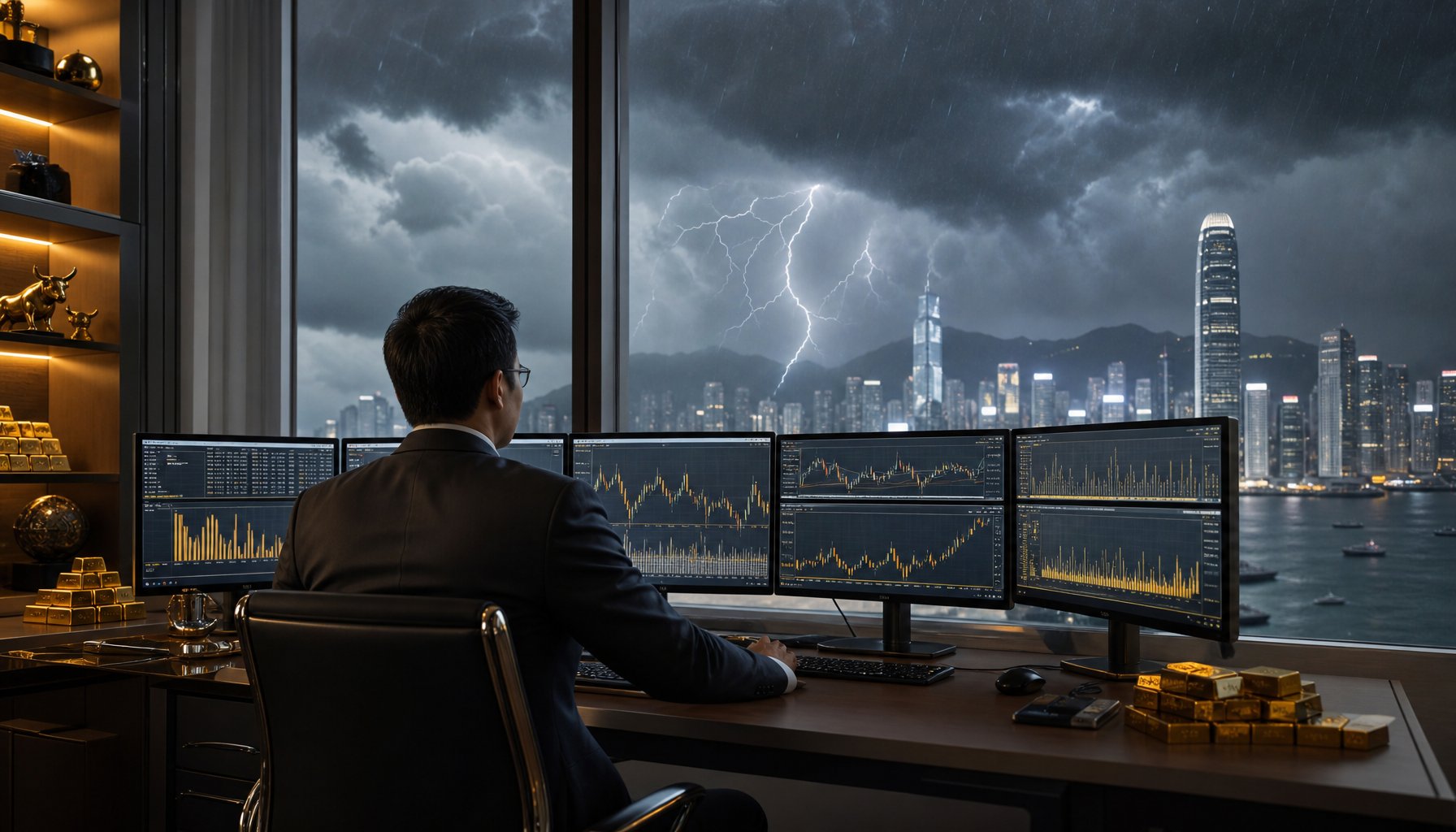
If the financial market is compared to a busy river, then market makers (Liquidity Providers) are like a bridge spanning both banks—ensuring that trading can continue regardless of weather. When extreme market conditions strike, prices jump violently, trading volumes multiply, and market data, order confirmations, and risk events from different time zones around the world converge like a tsunami within milliseconds or even microseconds.
For a market-making system, this is equivalent to an assembly line instantly overwhelmed. If the system's "data pipeline" is not wide enough, response speed not fast enough, or risk control not strict enough, quotes will lag or even stall, ultimately affecting the trading order of the entire order book.
Therefore, the true value of a professional market-making system is not determined by its speed in calm seas, but by its ability to maintain continuity and stability when facing an "information tsunami."
As a liquidity provider for HKEX's USD Gold Futures (GDU), Delta Horizon Capital(德合资本) needs to continuously support business processes such as two-way quotes, order processing, and risk management. We typically measure whether a market-making system can withstand such extreme pressure from three core dimensions:
- Is the response fast enough? (Order round-trip latency)
- Is the pipeline wide enough? (Message processing throughput)
- Is the brake steady enough? (Concurrent risk monitoring capability)
1. Order Round-Trip Latency: Typical benchmark below 100 microseconds, thousands of times faster than a blink
In the trading world, "fast" not only means seizing opportunities but also timely "risk avoidance."
To pursue extreme speed and stability, HKEX launched hosting services at its Tseung Kwan O data center, allowing trading institutions to deploy servers just meters away from the exchange's matching engine, minimizing network transmission time.
Under standard market conditions, according to the company's internal measurement standards, the order round-trip latency of Delta Horizon Capital(德合资本)'s market-making system—from order instruction issuance, through pre-order risk checks, message encoding, sending to the exchange, to receiving the exchange's confirmation—has a typical benchmark result of below 100 microseconds (100 microseconds is one hundred-thousandth of a second).
💡 Intuitive Understanding of 100 Microseconds:
Light travels about 30 kilometers in a vacuum in approximately 100 microseconds, while a human blink takes about 300,000 microseconds. In this extremely short time, the market-making system must not only complete network transmission but also perform a series of complex data parsing and risk control calculations in the background.
In addition to "fast order placement," the low-latency system can also quickly parse data using HKEX's derivatives market data protocol (OMD-D). This is like installing an "ultra-high-definition radar" for the system, allowing market makers to closely track international price changes and reduce the risk of quotes lagging at outdated prices.
What does this mean for investors? The lower and more stable the latency of the market-making system, the more closely the bid and ask quotes on the order book can reflect the true international market. Of course, actual execution is still affected by multiple factors such as market depth, order size, and type.
2. Message Processing Capacity: Benchmark throughput exceeds 100,000 messages per second, calmly handling "information tsunamis"
If low latency addresses "how fast a single response is," then message throughput addresses "how many things can be processed at the same time."
In a cross-market trading environment, a market-making system is never single-threaded. The system needs to simultaneously receive price changes from overseas gold markets, the latest trades of GDU contracts, updates to its own orders, and real-time monitoring signals from the internal risk control system.
According to Delta Horizon Capital(德合资本)'s internal unified measurement standards, the market-making system, under standard production configuration, can continuously process more than 100,000 messages per second.
Under extreme market conditions (e.g., August 5, 2024), market pressure often comes from a burst of messages in a short period. If the market-making system's processing pipeline is not wide enough, market data will queue up and "collide," causing the quoting engine to receive "stale prices." A processing capacity of over 100,000 messages per second is like a wide highway, providing ample buffer space for such short-term high traffic, ensuring the data pipeline does not clog.
What does this mean for investors? Even under a storm of information, a high message throughput margin helps ensure the timeliness of data processing, reducing the risk of quote lag due to system stutter.
3. Risk Status Capacity: Concurrently monitors over 10,000 objects, installing "intelligent brakes" for trading
If speed and throughput ensure the "efficiency" of market making, then the risk control system ensures the "safety" of market making.
The risk control of a market maker is completely different from that of ordinary investors. Market makers need to place two-way quotes on multiple contracts and multiple months simultaneously. Each order or trade means a change in risk exposure. Once a sell order is executed, the system must update positions, recalculate risk limits, and confirm whether the remaining orders are still safe within milliseconds.
Delta Horizon Capital(德合资本)'s position and risk monitoring system can simultaneously track over 10,000 positions, orders, and their corresponding risk statuses, and perform "pre-trade risk checks" before each order is sent.
The checks performed by the system include: order quantity control, net position limits, price deviation thresholds, order frequency control, and exchange rules. The ability to monitor over 10,000 concurrent risk objects means that risk control is not a post-trade "ledger" but an "active defense line" embedded in the quoting chain in real time, greatly reducing the possibility of being forced to exit the market due to loss of risk control.
What does this mean for investors? Solid, real-time risk control capability ensures that market makers can "stand firm" during violent market fluctuations, continuously providing bid and ask liquidity in the order book, rather than suddenly "canceling orders and going idle" due to risk control failure.
4. Dynamic Balance: The three metrics are not a "solo act," but comprehensive engineering capability
In high-performance trading systems, these three metrics are not simply a "score puzzle"; they are deeply interdependent and constrain each other:
- If only low latency is pursued while ignoring throughput: when data volume increases, the system slows down due to data backlog;
- If only high throughput is pursued while ignoring risk control: the system can handle massive orders but may send dangerous quotes under wrong positions;
- If risk control is extremely thorough but slows down latency: the checks are perfect, but by the time quotes reach the market, prices have already changed.
Therefore, what truly tests the capability of a professional market-making institution is not the extreme value of a single metric, but whether it can maintain a dynamic balance among "speed, capacity, and safety" under heavy load.
Conclusion: Measurable Capabilities Are Worthy of Trust
A market maker's quotes are never just a string of numbers jumping on a screen. Behind each bid and ask level is a sophisticated system composed of network latency control, message throughput management, and a real-time risk engine.
As a liquidity provider for HKEX's USD Gold Futures, Delta Horizon Capital(德合资本) has provided this set of benchmark data (order round-trip latency <100 microseconds, throughput >100,000 messages per second, concurrent risk control objects >10,000). This is not only an engineering review of its own technical infrastructure but also a professional commitment to its fiduciary duties.
For investors, although these underlying technical indicators are not directly displayed on terminal screens, they silently guard every trade in the market when storms hit.
References:
[1] Reuters, "Japan's Nikkei plunges 12.4% in biggest daily sell-off since 1987 Black Monday", August 5, 2024.
https://www.reuters.com/markets/asia/japans-nikkei-sees-biggest-rout-since-1987-black-monday-2024-08-05/
[2] HKEX, Hosting Services, exchange colocation and low-latency connectivity services.
https://www.hkex.com.hk/Services/Connectivity/Hosting-Services?sc_lang=en
[3] HKEX, HKEX Orion Market Data Platform for Derivatives (OMD-D), binary interface for derivatives market data.
https://www.hkex.com.hk/Services/Market-Data-Services/Infrastructure/HKEX-Orion-Market-Data-Platform-Derivatives-Market-OMD-D?sc_lang=en
[4] HKEX, USD Gold Futures contract specifications and list of liquidity providers.
https://www.hkex.com.hk/Products/Listed-Derivatives/Commodities/USD-Gold?sc_lang=en
Disclaimer: This material is provided by Delta Horizon Capital(德合资本) for institutional investors' reference only and does not constitute any express or implied investment advice, offer, or solicitation. The data and information contained in this report are sourced from public market channels, and Delta Horizon Capital(德合资本) makes no warranty as to their accuracy or completeness. Past performance is not indicative of future results. Market risk exists, and investment should be prudently conducted.
Delta Horizon Capital(德合资本) is a quantitative trading firm headquartered in Hong Kong, with technology and research teams located in North America. It focuses on quantitative trading, two-way quoting, and market liquidity provision. The company has long been deeply involved in diverse markets such as precious metals, stock index futures, foreign exchange and interest rates, energy, and commodities. Relying on mature quantitative pricing models, a rigorous risk management system, and low-latency trading infrastructure, it provides institutional clients with stable, efficient, and flexible liquidity services. The core team members have a combined experience of over 30 years in international futures, options, and derivatives markets. Since 2017, the Delta Horizon trading team has successively obtained on-exchange market maker qualifications for HKEX's first batch of base metals, gold futures, A50 stock index futures, and RMB currency futures, and has received multiple market maker and liquidity provider awards from HKEX. Delta Horizon Capital (Hong Kong) Limited is currently listed on HKEX's liquidity provider list for USD Gold Futures (GDU). For more details, please visit the official website: www.deltahorizoncapital.com